Showing posts with label presentations of mechanical. Show all posts

Sunday, 13 September 2015

HYDROGEN (WATER) POWERED VEHICLE

Introduction 


Finally the science of Hydrogen automotive power has been made a reality! Technically a device that converts the energy stored in hydrogen into motion can be called a Hydrogen engine. Hydrogen would make a great fuel for the environment since burning Hydrogen produces nothing but water!
Hydrogen Powered car essentially consists of the following
1)      Fuel tank
Liquid hydrogen is stored in a tank at the rear of the car and is pumped forward to the fuel cell stack as and when required.
2)      Fuel Cell Stack
When Hydrogen is combined with Oxygen in a fuel cell a chemical reaction creates electricity.

Hydrogen Powered vehicle


1)      Battery Pack
The battery pack is periodically recharged by the fuel cell. The power from the battery pack is used to provide rapid acceleration.
2)      Electric Motor
The stack provides electricity for the electric motor that powers the vehicle
Right from the year 1625, when Johann Baptista van Helmont discovered the gas, Hydrogen; people were curious enough to find the uses of the new found gas. It nearly took a mind boggling 181 years to develop an internal combustion engine which runs on a mixture of hydrogen and water by the icon of 18th century who is none other than, Francois Issac de Rivaz. The Swiss inventor, is credited with the development and construction of the world’s first IC engine back in 1806. From then onwards, it was always a challenge to develop the best IC engine. This has lead to developing different varieties of engines.
A pictorial representation of the Hydrogen powered vehicle is shown below.
Hydrogen Powered vehicle


Howercraft

Introduction

 Howercraft is like a miracle machine ,it can works on water as well as land.


HOW TO MAKE A HOVERCRAFT


        The idea of making a Hovercraft dates back to 1716 when Emmanual Swedenborg recorded a design, but it was short lived.  In 1870, Sir John Thornycroft filled patents involving air lubricated hulls. And it was in 1959 a hovercraft was built, by Christopher Sydney Cockerell  by discovering the Momentum Curtain theory. Hover craft also called Air cushion vehicle (ACV) travels on any kind of flat surface. It is supported by a cushion of pressurized air.


Design
  1. Can be powered by one or more engines
  2. Small crafts have a single engine with the drive split through a gear box 
  3. Usually one engine drives the fan responsible for lifting the vehicle
  4. The other forces air from
hovercraft

Working
Two main principles:
1)      Lift
2)      Propulsion
  1. A skirt is required to quarantine airflow 
  2. No contact with ground hence friction is eliminated
  3. The shape of the body affects stability
  4. All parts are essential for proper working

Parts
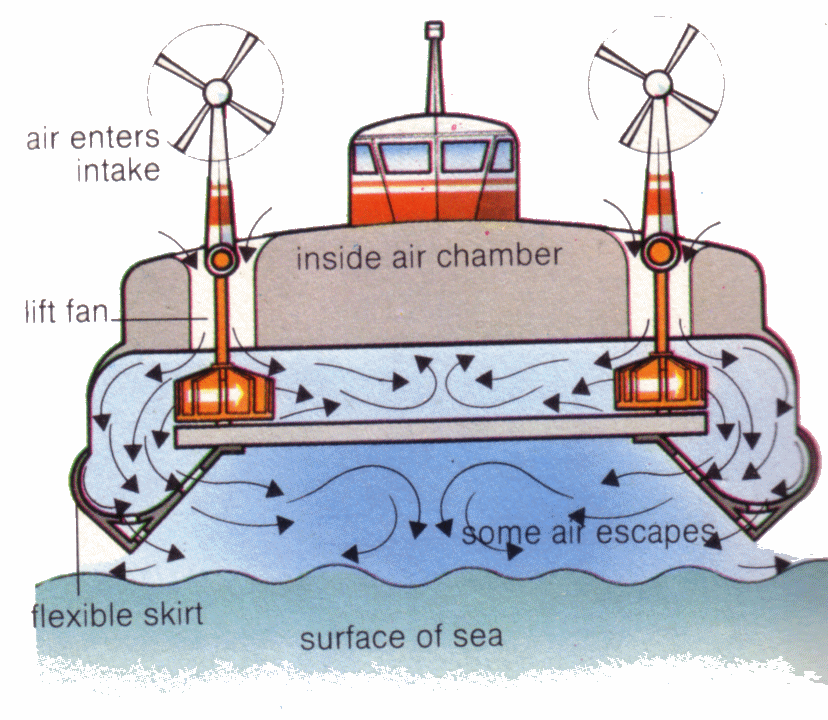
1)      Lifting fan: Usually a centrifugal fan is preferred. When rotated air is sucked into the center hole, it is coupled via a gearbox and connected to the engine
2)      Thrust propellers: An aircraft type propeller with variable type pitch blades. Diameter ranges from nine feet to nineteen feet. In bigger crafts the propellers are rotated while in smaller ones, rudders are used.
3)      Skirt: Flexible strip which is fitted below the bottom edges of the plenum chamber. Skirt design is the most sensitive design parameter as it protects the craft and helps to lift it even higher.

hovercraft diagram

In theory hovercrafts are simple machines but a plethora of problems exist to make a functioning hovercraft. The plans as well as the design must be flawless. To build a hovercraft one must be well aware of the demands of construction. Only then can one design a hovercraft.

Uses : In transport.


Reference video : https://youtu.be/1OMSdA4-Gn4

Friday, 11 September 2015

Two stroke engines

Introduction

            In two stroke cycle engines, the whole sequence of events i.e., suction, compression, power and exhaust are completed in two strokes of the piston i.e. one revolution of the crankshaft. There is no valve in this type of engine. Gas movement takes place through holes called ports in the cylinder. The crankcase of the engine is air tight in which the crankshaft rotates. 


Upward stroke of the piston (Suction + Compression)

               When the piston moves upward it covers two of the ports, the exhaust port and transfer port, which are normally almost opposite to each other. This traps the charge of air- fuel mixture drawn already in to the cylinder. Further upward movement of the piston compresses the charge and also uncovers the suction port. Now fresh mixture is drawn through this port into the crankcase. Just before the end of this stroke, the mixture in the cylinder is ignited by a spark plug. Thus, during this stroke both suction and compression events are completed.


Downward stroke (Power + Exhaust)

              Burning of the fuel rises the temperature and pressure of the gases which forces the piston to move down the cylinder. When the piston moves down, it closes the suction port, trapping the fresh charge drawn into the crankcase during the previous upward stroke. Further downward movement of the piston uncovers first the exhaust port and then the transfer port. Now fresh charge in the crankcase moves in to the cylinder through the transfer port driving out the burnt gases through the exhaust port. Special shaped piston crown deflect the incoming mixture up around the cylinder so that it can help in driving out the exhaust gases . During the downward stroke of the piston power and exhaust events are completed.  


Application 
  • Lawn and garden equipment (chain saws, leaf blowers, trimmers)
  • Dirt bikes
  • Mopeds
  • Jet skis
  • Small outboard motors
  • Radio-controlled model planes

Reference video : https://youtu.be/EKQprWAHFTk

CRDI (Common Rail Direct Injection)

Introduction


       CRDi stands for Common Rail Direct Injection meaning, direct injection of the fuel into the cylinders of a diesel engine via a single, common line, called the common rail which is connected to all the fuel injectors.


    Whereas ordinary diesel direct fuel-injection systems have to build up pressure anew for each and every injection cycle, the new common rail (line) engines maintain constant pressure regardless of the injection sequence. This pressure then remains permanently available throughout the fuel line. The engine's electronic timing regulates injection pressure according to engine speed and load. The electronic control unit (ECU) modifies injection pressure precisely and as needed, based on data obtained from sensors on the cam and crankshafts. In other words, compression and injection occur independently of each other. This technique allows fuel to be injected as needed, saving fuel and lowering emissions.

     More accurately measured and timed mixture spray in the combustion chamber significantly reducing unburned fuel gives CRDi the potential to meet future emission guidelines such as Euro V. CRDi engines are now being used in almost all Mercedes-Benz, Toyota, Hyundai, Ford and many other diesel automobiles.


History


     The common rail system prototype was developed in the late 1960s by Robert Huber of Switzerland and the technology further developed by Dr. Marco Ganser at the Swiss Federal Institute of Technology in Zurich, later of Ganser-Hydromag AG (est.1995) in Oberägeri. The first successful usage in a production vehicle began in Japan by the mid-1990s. Modern common rail systems, whilst working on the same principle, are governed by an engine control unit (ECU) which opens each injector electronically rather than mechanically. This was extensively prototyped in the 1990s with collaboration between Magneti Marelli, Centro Ricerche Fiat and Elasis. The first passenger car that used the common rail system was the 1997 model Alfa Romeo 156 2.4 JTD, and later on that same year Mercedes-Benz C 220 CDI.

     Common rail engines have been used in marine and locomotive applications for some time. The Cooper-Bessemer GN-8 (circa 1942) is an example of a hydraulically operated common rail diesel engine, also known as a modified common rail. Vickers used common rail systems in submarine engines circa 1916. Early engines had a pair of timing cams, one for ahead running and one for astern. Later engines had two injectors per cylinder, and the final series of constant-pressure turbocharged engines were fitted with four injectors per cylinder. This system was used for the injection of both diesel oil and heavy fuel oil (600cSt heated to a temperature of approximately 130 °C). The common rail system is suitable for all types of road cars with diesel engines, ranging from city cars such as the Fiat Nuova Panda to executive cars such as the Audi A6.

Operating Principle


     Solenoid or piezoelectric valves make possible fine electronic control over the fuel injection time and quantity, and the higher pressure that the common rail technology makes available provides better fuel atomisation. In order to lower engine noise, the engine's electronic control unit can inject a small amount of diesel just before the main injection event ("pilot" injection), thus reducing its explosiveness and vibration, as well as optimizing injection timing and quantity for variations in fuel quality, cold starting and so on. Some advanced common rail fuel systems perform as many as five injections per stroke.

     Common rail engines require very short (< 10 second) or no heating-up time at all , dependent on ambient temperature, and produce lower engine noise and emissions than older systems. Diesel engines have historically used various forms of fuel injection. Two common types include the unit injection system and the distributor/inline pump systems (See diesel engine and unit injector for more information). While these older systems provided accurate fuel quantity and injection timing control, they were limited by several factors:

• They were cam driven, and injection pressure was proportional to engine speed. This typically meant that the highest injection pressure could only be achieved at the highest engine speed and the maximum achievable injection pressure decreased as engine speed decreased. This relationship is true with all pumps, even those used on common rail systems; with the unit or distributor systems, however, the injection pressure is tied to the instantaneous pressure of a single pumping event with no accumulator, and thus the relationship is more prominent and troublesome.


• They were limited in the number and timing of injection events that could be commanded during a single combustion event. While multiple injection events are possible with these older systems, it is much more difficult and costly to achieve.


• For the typical distributor/inline system, the start of injection occurred at a pre-determined pressure (often referred to as: pop pressure) and ended at a pre-determined pressure. This characteristic resulted from "dummy" injectors in the cylinder head which opened and closed at pressures determined by the spring preload applied to the plunger in the injector. Once the pressure in the injector reached a pre-determined level, the plunger would lift and injection would start.


     In common rail systems, a high-pressure pump stores a reservoir of fuel at high pressure — up to and above 2,000 bars (psi). The term "common rail" refers to the fact that all of the fuel injectors are supplied by a common fuel rail which is nothing more than a pressure accumulator where the fuel is stored at high pressure. This accumulator supplies multiple fuel injectors with high-pressure fuel. This simplifies the purpose of the high-pressure pump in that it only has to maintain a commanded pressure at a target (either mechanically or electronically controlled). The fuel injectors are typically ECU-controlled. When the fuel injectors are electrically activated, a hydraulic valve (consisting of a nozzle and plunger) is mechanically or hydraulically opened and fuel is sprayed into the cylinders at the desired pressure. Since the fuel pressure energy is stored remotely and the injectors are electrically actuated, the injection pressure at the start and end of injection is very near the pressure in the accumulator (rail), thus producing a square injection rate. If the accumulator, pump and plumbing are sized properly, the injection pressure and rate will be the same for each of the multiple injection events.


Advantages

     CRDi engines are advantageous in many ways. Cars fitted with this new engine technology are believed to deliver 25% more power and torque than the normal direct injection engine. It also offers superior pick up, lower levels of noise and vibration, higher mileage, lower emissions, lower fuel consumption, and improved performance.

      In India, diesel is cheaper than petrol and this fact adds to the credibility of the common rail direct injection system.


Disadvantages

    Like all good things have a negative side, this engine also have few disadvantages. The key disadvantage of the CRDi engine is that it is costly than the conventional engine. The list also includes high degree of engine maintenance and costly spare parts. Also this technology can’t be employed to ordinary engines.


Applications


     The most common applications of common rail engines are marine and locomotive applications. Also, in the present day they are widely used in a variety of car models ranging from city cars to premium executive cars.

     Some of the Indian car manufacturers who have widely accepted the use of common rail diesel engine in their respective car models are the Hyundai Motors, Maruti Suzuki, Fiat, General Motors, Honda Motors, and the Skoda. In the list of luxury car manufacturers, the Mercedes-Benz and BMW have also adopted this advanced engine technology. All the car manufacturers have given their own unique names to the common CRDi engine system.

     However, most of the car manufacturers have started using the new engine concept and are appreciating the long term benefits of the same. The technology that has revolutionized the diesel engine market is now gaining prominence in the global car industry.

     CRDi technology revolutionized diesel engines and also petrol engines (by introduction of GDI technology).

     By introduction of CRDi a lot of advantages are obtained, some of them are, more power is developed, increased fuel efficiency, reduced noise, more stability, pollutants are reduced, particulates of exhaust are reduced, exhaust gas recirculation is enhanced, precise injection timing is obtained, pilot and post injection increase the combustion quality, more pulverization of fuel is obtained, very high injection pressure can be achieved, the powerful microcomputer make the whole system more perfect, it doubles the torque at lower engine speeds. The main disadvantage is that this technology increase the cost of the engine. Also this technology can’t be employed to ordinary engines


Uses in : Mercedes-Benz, Toyota, Hyundai, Ford


Reference video : https://youtu.be/jDRa1cSJhSQ
                          https://youtu.be/7yy27APhpHA

i-VTEC

Introduction

              The most important challenge facing car manufacturers today is to offer vehicles that deliver excellent fuel efficiency and superb performance while maintaining cleaner emissions and driving comfort. This paper deals with i-VTEC (intelligent-Variable valve Timing and lift Electronic Control) engine technology which is one of the advanced technology in the IC engine. i-VTEC is the new trend in Honda's latest large capacity four cylinder petrol engine family. The name is derived from 'intelligent' combThe most important challenge facing car manufacturers today is to offer vehicles that deliver excellent fuel efficiency and superb performance while maintaining cleaner emissions and driving comfort. This paper deals with  i-VTEC(intelligent-Variable valve Timing and lift Electronic Control) engine technology which is one of the advanced technology in the IC engine. i-VTEC is the new trend in Honda's latest large capacity four cylinder petrol engine family. The name is derived from 'intelligent' combustion control technologies that match outstanding fuel economy, cleaner emissions and reduced weight with high output and greatly improved torque characteristics in all speed range. The design cleverly combines the highly renowned VTEC system which varies the timing and amount of lift of the valves with Variable Timing Control.

           VTC (Variable Timing Control) is able to advance and retard inlet valve opening by altering the phasing of the inlet camshaft to best match the engine load at any given moment. The two systems work in concern under the close control of the engine management system delivering improved cylinder charging and combustion efficiency, reduced intake resistance, and improved exhaust gas recirculation among the benefits. i-VTEC technology offers tremendous flexibility since it is able to fully maximize engine potential over its complete range of operation. In short Honda's i-VTEC technology gives us the best in vehicle performance.

        The latest and most sophisticated VTEC development is i-VTEC ("intelligent" VTEC), which combines features of all the various previous VTEC systems for even greater power band width and cleaner emissions. With the latest i-VTEC setup, at low rpm the timing of the intake valves is now staggered and their lift is asymmetric, which creates a swirl effect within the combustion chambers. At high rpm, the VTEC transitions as previously into a high-lift, long-duration cam profile.

               The i-VTEC system utilizes Honda's proprietary VTEC system and adds VTC (Variable Timing Control), which allows for dynamic/continuous intake valve timing and overlap control. The demanding aspects of fuel economy, ample torque, and clean emissions can all be controlled and provided at a higher level with VTEC (intake valve timing and lift control) and VTC (valve overlap control) combinedustion control technologies that match outstanding fuel economy, cleaner emissions and reduced weight with high output and greatly improved torque characteristics in all speed range. The design cleverly combines the highly renowned VTEC system - which varies the timing and amount of lift of the valves - with Variable Timing Control.

             VTC is able to advance and retard inlet valve opening by altering the phasing of the inlet camshaft to best match the engine load at any given moment. The two systems work in concern under the close control of the engine management system delivering improved cylinder charging and combustion efficiency, reduced intake resistance, and improved exhaust gas recirculation among the benefits. i-VTEC technology offers tremendous flexibility since it is able to fully maximize engine potential over its complete range of operation. In short Honda's i-VTEC technology gives us the best in vehicle performance.
The latest and most sophisticated VTEC development is i-VTEC ("intelligent" VTEC), which combines features of all the various previous VTEC systems for even greater power band width and cleaner emissions. With the latest i-VTEC setup, at low rpm the timing of the intake valves is now staggered and their lift is asymmetric, which creates a swirl effect within the combustion chambers. At high rpm, the VTEC transitions as previously into a high-lift, long-duration cam profile.

             The i-VTEC system utilizes Honda's proprietary VTEC system and adds VTC (Variable Timing Control), which allows for dynamic/continuous intake valve timing and overlap control. The demanding aspects of fuel economy, ample torque, and clean  emissions can all be controlled and provided at a higher level with VTEC (intake valve timing and lift control) and VTC (valve overlap control) combined.


            The i stands for intelligent: i-VTEC is intelligent-VTEC. Honda introduced many new innovations in i-VTEC, but the most significant one is the addition of a variable valve opening overlap mechanism to the VTEC system. Named VTC for Variable Timing Control, the current (initial) implementation is on the intake camshaft and allows the valve opening overlap between the intake and exhaust valves to be continuously varied during engine operation. This allows for a further refinement to the power delivery characteristics of VTEC, permitting fine-tuning of the mid-band power delivery of the engine.

Uses in : Honda

Reference video : https://youtu.be/UEtm2y1yXnI